Showing posts with label Orang asli. Show all posts

Tuesday, 30 March 2010

20 Years Without Water and Electricity

This is how the government treats the orang asli. Is it so difficult to provide even the most basic amenities to them? Yet, recently a government official in an international seminar trumpeted that Malaysia treats her indigenous people the best. The Bernama report below shows how well they are taken care of from 'womb to grave', as the official proudly put it.

Mar 29, 10 6:56pm

For over 20 years, 30 Orang Asli families residing in the Kampung Pelam Hardcore Poor Housing Project, near Rompin in Pahang, have lived without electricity and clean water supply.

The village chief, Husin Dagang, said the residents had to purchase a generator and depend on rain and well water to carry out daily activities such as cooking, bathing and cleaning.

Husin, 50, said each family spent RM500 on diesel to run the generators and those who could not afford one would live in darkness.

"We have to spend part of our income on the generator, but we don't have the academic qualifications and only work in the village so we can't afford to fork out this much money," he said when met here.

He said the villagers had voiced out their woes to local leaders, but had yet to see any action taken to provide the basic facilities.

"When we ask the local leaders they say water and electricity will be available soon, but the matter has yet to be resolved," he said.

A villager, Halim Abas, 38, said the lack of basic facilities caused residents to experience stomach-ache and vomitting because they had to share well water and use rain water.

Having no electricity made it difficult for the children to revise their studies at night as they only had oil lamps, he added.

"We hope the government will do something soon to overcome this problem as the residents cannot wait much longer," he said.

Bernama

Sunday, 28 March 2010

"Malaysia Best in Handling Indigenous people's Rights"

....said the Malaysian government representative, Datuk Dr. Marcus Mojigoh at today's Asia-Pacific Parliamentarians' Conference on Environment and Development. His claim which came at the back of the recent historic protest by 2000 orang asli at Putrajaya, the administrative capital of the country and a doctor's public disclosure of malpractices and misappropriation of resources at a orang asli hospital must have raised not a few participants' eyebrows. According to Dr. Mojigoh, the orang asli must be a contented lot as the government has cared for them from 'womb to grave'. The reality of this marginalized people, numbering only 141,230 is far from the rosy picture he has painted. Perhaps he should have claimed that in the Asia-Pacific region, Malaysia is the least worst country in handling her indigenous people.

Some statistics:
  • (2004) while the national poverty rate is 6.5%, that of the orang asli is 76.9%,
  • (2003) while the national hardcore poor rate is 1.4% that of the orang asli is 35.2%,
  • (2003) they make up 53.6% of recorded Malaria cases,
  • (2002) 19.63% of the population has leprosy,
  • vast majority of orang asli children are undernourished and stunted,
  • although more and more orang asli children are enrolled in primary and secondary schools, the dropout rate is high; for instance for every 100 orang asli children entering Primary 1, only 6 will be expected to reach Form 5.
And the list goes on. Below are some excerpts from papers highlighting the plight of the orang asli:


Not only are they the most marginalized, they are also facing the spectre of losing their claims on their ancestral lands. Their way of life has also been threatened by a government bent on converting them:


Read here for further anecdotal account.

Thursday, 25 March 2010

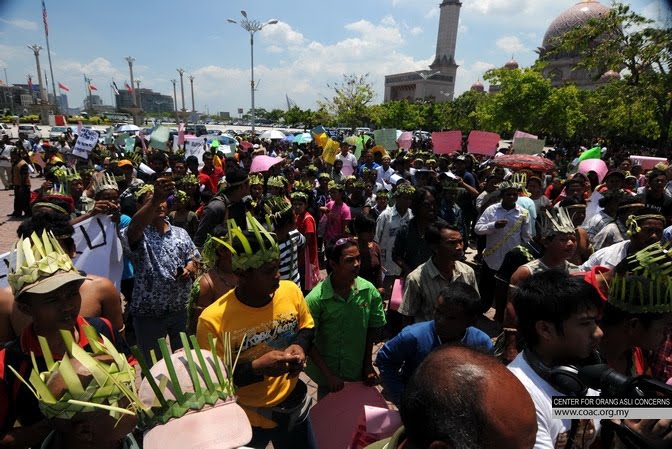
More Photos of Orang Asli Protest

Reading through some of the documents found at the website, Centre for Orang Asli Concerns, I felt that the Orang Asli are but one of the many instances which have shown that the present government cannot be trusted. For 52 years, the Orang Asal have been treated rather shabbily by the government which is supposed to protect their interest. The government has reneged on its promise to gazette their ancestral lands so that they could continue to live the way they prefer; instead it has converted some of these lands as government reserve lands for development. Invariably, some of these lands have been leased out to oil palm and timber tycoons.


Photos from Center of Orang Asli Concerns

Thursday, 18 March 2010

Are Orang Asli Bumiputras?

Yesterday, more than two thousand orang asli (some would prefer to call them orang asal), complete with their traditional gear converged on Putrajaya to protest against a new land policy which seems to shortchange them and demand recognition of their rights to their ancestral lands. Under the policy each family is to be given 2.4ha for agriculture and 0.1ha to build their houses. Prior to this protest, a Gombak orang asli hospital doctor who went public with her allegations of mismanagement and cronyism at the hospital was prevented from carrying out her duties and was later transferred out of the hospital. Coincidentally, after her transfer, the hospital director was also removed from the hospital.


Are the orang asli bumiputras? The constitution seems ambiguous on their status. Some would argue that it includes the orang asli in the peninsula (the defacto Law Minister for instance) while others contend that bumiputras refer specifically to Muslim Malays and the natives of Sabah and Sarawak. The interpretation of 'bumiputra' by various public institutions seems to exclude the orang asal. For instance, the Higher Education Ministry defines a bumiputra as:
  • in Peninsular Malaysia, if one of the parents is a Muslim Malay the child is a bumiputra,
  • in Sabah, if the father is a Muslim Malay or an indigenous native, his child is a bumiputra,
  • in Sarawak, if both parents are indigenous natives, their child is a bumiputra.
Where do the orang asli fit in? It seems that they have forgotten about the orang asal, the presumption being few if any would make it to colleges or universities. So what's the big deal?

The upshot of of this is that even the marginalized orang asal who have been suffering in abject silence have for once decided to stand up for their rights. Were they emboldened by the recent success of their counterparts in Sarawak who were successful in legally wrestling back their land from the Sarawak State government?

Read here and here for more.